
Custom Airbrushed 3D Lobby Logo Signs: A Production Guide
Airbrushing can add gradients, highlights, and texture to dimensional lettering. A strong production brief connects approved artwork and dimensions with the finish and installer handoff.
Key takeaways
- Airbrushing can create controlled gradients and highlights that a single flat color cannot.
- Final vector artwork, customer-verified dimensions, and an installer-approved mounting plan should come before fabrication.
- Lighting, wall color, texture, and viewing angle determine how much depth the finished logo appears to have.
- Topcoat and cleaning recommendations must match the specific paint system rather than a one-size-fits-all care routine.
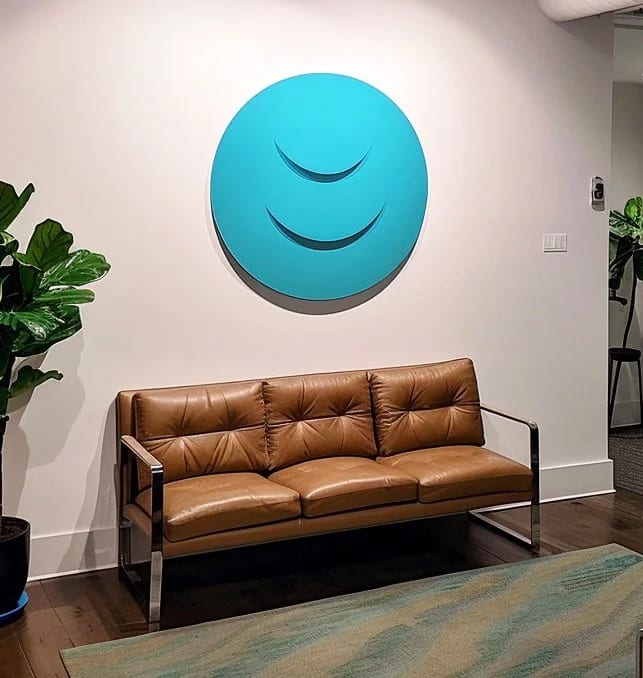
A lobby logo often has to do two jobs at once: identify the organization and belong in the interior. Dimensional pieces create real shadow; an airbrushed finish can add controlled gradients, highlights, or texture where a flat color would miss part of the brand.
The effect is only as good as the planning behind it. This guide covers the artwork, material, finish, verified dimensions, and installer-handoff details to resolve before an office or reception logo reaches production.
What is an airbrushed 3D lobby logo?
A 3D lobby logo uses cut, routed, cast, or layered elements mounted to an interior wall, commonly near reception. Airbrushing applies paint in fine, controlled passes. It can produce a fade across a letter face, shade an edge, or add a small highlight without printing a flat simulation of depth.
Airbrushing is not necessary for every logo. Simple brand colors may be better served by a uniform paint, film, or printed face. The technique earns its place when the finish contributes something visible and repeatable at the intended viewing distance.
Why airbrushing works on dimensional logo signs
Airbrushing is useful when the artwork needs nuance without becoming a wall mural. Common applications include:
- Controlled gradients: transitions that would be difficult to reproduce with a single sprayed coat.
- Depth cues: edge shading and highlights that reinforce the form of layered pieces.
- Project-specific color: a finish proofed for the brand palette and the room’s actual lighting.
- Selective texture: a visual treatment used intentionally rather than added to every surface.
Because perception changes with light source and sheen, approve a physical finish sample when color or gradient accuracy matters. A screen proof cannot show exactly how a painted surface will react under lobby lighting.
What to supply before dimensional-logo production
A production-ready order connects the shop file to field information verified by the customer, designer, or qualified installer. Before fabrication, confirm:
- Final vector artwork: production files with approved spacing plus decisions about very small or fragile shapes.
- Approved finished size: customer-verified dimensions and a scaled elevation showing the logo width, centerline, furniture, and nearby architectural features.
- Installer specifications: wall substrate, backing information, mounting-hole or stud pattern, and clearance requirements approved for the actual site.
- Finish direction: reference colors, sheen, gradient placement, and any physical sample needed before the full paint sequence.
- Lighting context: customer-supplied information about fixture direction, glare, and the amount of real shadow desired.
- Handoff requirements: piece labels, mounting pattern, approved hardware specification, assembly notes, and packaging needed by the installer.
LA Prime Signs produces dimensional components from customer-approved artwork and specifications. The customer and qualified installer remain responsible for final field measurements, site verification, mounting design, structural suitability, concealed utilities, approvals, access, and installation. The installation-ready production guide explains what to coordinate for handoff.
The artwork setup guide explains how to prepare source files for production.
Materials and finishes that pair well with airbrushing
The substrate affects edge quality, weight, minimum stroke width, sheen, and paint preparation. Layered panels can create broad shapes; individually cut letters can make the wall itself part of the composition. Primer, color layers, and clear coat must be compatible as a system.
Acrylic can provide crisp faces and layered depth, while Dibond can suit broad, stable panel elements. Other plastics or metals may make more sense for narrow strokes, deeper returns, or a different edge treatment. Choose from the logo geometry and mounting conditions rather than from a material name alone.
Placement and lighting: make it read from the door
Dimensional logos change as the viewer moves and as daylight shifts. In naturally lit interiors with strong window exposure, review both daytime glare and evening illumination instead of approving the sign under one condition. A useful checklist includes:
- Sightlines: where visitors first see the wall, from what angle, and whether doors or people block the view.
- Contrast: whether the face and edges separate from the wall in both bright and dim conditions.
- Glare: whether glossy paint, windows, or downlights obscure fine finish work.
- Shadow control: whether projection and fixture direction create intentional shadows or visual clutter.
How to maintain an airbrushed logo wall
Care depends on the specified paint and topcoat, but a few conservative habits apply to most interior dimensional signs:
- Dust gently: use a clean, soft cloth without forcing narrow strokes or projecting pieces.
- Check before cleaning: use only products approved for the finish, and test in an inconspicuous area.
- Watch mounting points: have movement, gaps, or loose pieces evaluated before they become damage.
- Plan for exposure: discuss a compatible topcoat when the wall receives direct sun, frequent touching, or intensive cleaning.
Request production for a custom lobby logo
Review dimensional sign production, then share approved artwork, finished dimensions, finish direction, quantity, and installer-handoff requirements through the Quick Quote form. LA Prime Signs can print, cut, paint, finish, assemble, label, and package the approved sign components; field work is not included.
FAQ
How long does it take to create a custom airbrushed 3D logo?
Production timing depends on artwork readiness, material availability, finish complexity, quantity, proof approvals, and the approved mounting pattern. A project-specific schedule can be prepared after those production inputs are supplied.
What affects the cost of a 3D lobby logo sign?
Production variables include overall size, number and depth of pieces, substrate, paint steps, finish samples, mounting-pattern requirements, and packaging. Field measurement, access, and installation are separate customer or installer responsibilities.
Can the same logo be made in different materials?
Often, but the artwork may need production adjustments for small counters, narrow strokes, and unsupported shapes. Acrylic, metal, and composite materials also create different edges, weight, depth, and finish behavior.
Where should a lobby logo go for the best impact?
The customer and project designer should evaluate the primary approach, reception sightline, contrast, glare, door swings, furniture, and wall obstructions. Their approved scaled elevation and verified dimensions should define production placement.
How do you maintain an airbrushed 3D logo wall?
Use a soft cloth and the cleaner approved for the specified paint and topcoat. Avoid soaking edges or pulling on individual pieces, and have a qualified installer evaluate loose pieces or mounting points.