
Mars 130 CO2 Laser Guide for Custom Sign Components
A Mars 130 can be a useful reference point for CO2 laser production, but the model name is not a settings recipe. Safe, repeatable sign work starts with the exact machine, verified material, approved exhaust and cooling, and a documented test matrix.
Key takeaways
- Verify the exact laser source, usable bed, optics, controller, exhaust, air assist, cooling, and interlocks; machines sold under similar names can differ.
- Published speed-and-power charts are starting references only. Test the actual material, thickness, batch, masking, lens, focus, and finish target.
- A typical CO2 laser can cut or engrave selected wood and acrylic products, but it does not directly engrave most bare metals and is unsafe for some plastics.
- Never process unidentified material. Review supplier documentation and safety data before heat can release corrosive, toxic, or combustible fumes.
- Keep the enclosure and safety systems intact, use suitable extraction, maintain a continuous fire watch, and follow the machine manufacturer’s operating and maintenance instructions.
- Final dimensions, mounting requirements, site verification, access, and installation remain with the customer and qualified installer.
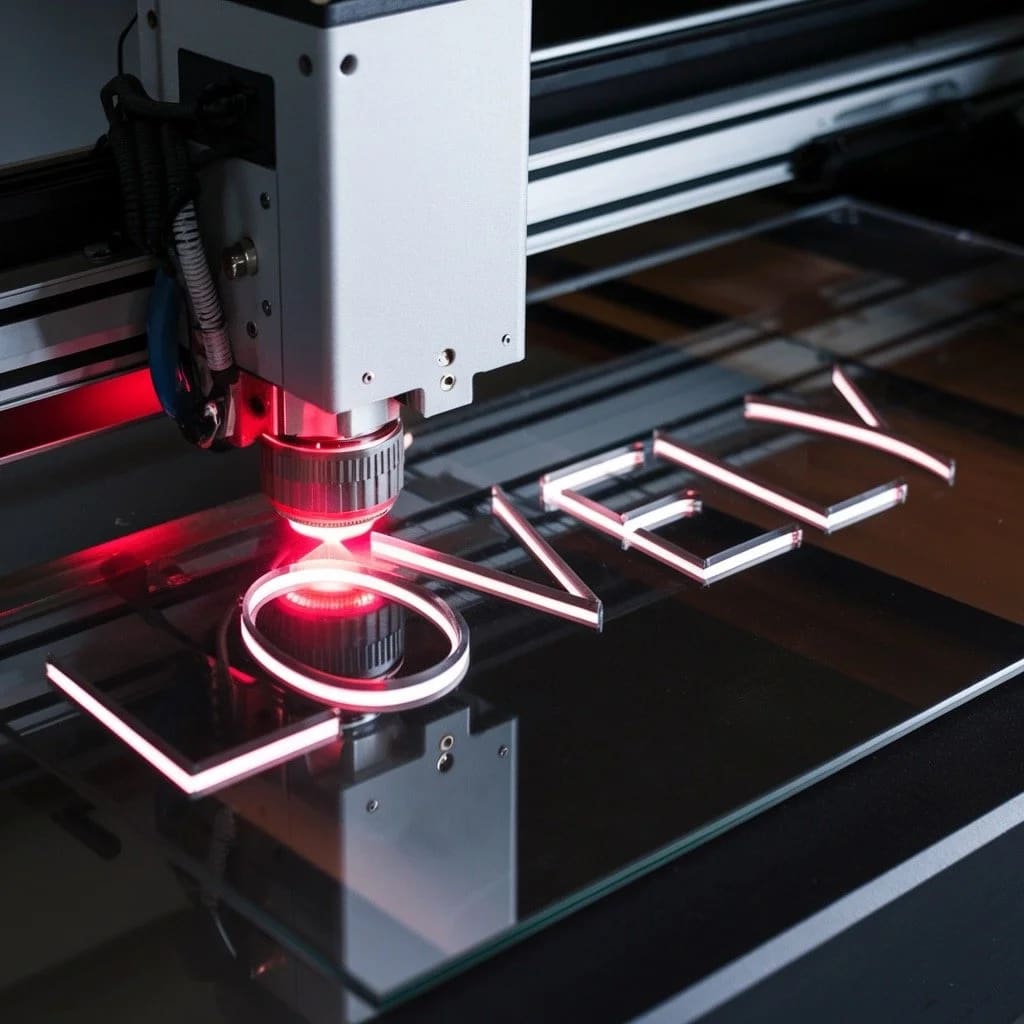
A CO2 laser can be useful for detailed acrylic sign components, engraved plaques, templates, masks, and selected wood parts. The Mars 130 is the model named in this guide, but similar model names can cover different tubes, controllers, optics, beds, and safety systems. Verify the equipment nameplate and manual before treating any specification or setting as applicable.
Laser production is only the right method when the material is positively identified, the finish target is realistic, and the machine’s enclosure, extraction, air assist, cooling, fire controls, and operator procedures suit the job. This article is planning guidance, not a claim that a particular shop owns this equipment or accepts every material discussed.
What should you verify before using a Mars 130 for signage?
Wattage and bed size matter, but they do not establish edge quality, safe material compatibility, resolution, or throughput. Record the actual configuration before quoting or programming work:
- Laser and rated output: Confirm the source type, wavelength, tube rating, condition, and manufacturer limits.
- Usable work area and Z clearance: The physical bed is not always the usable cut area, especially with fixtures or rotary accessories.
- Optics and motion: Lens focal length, beam alignment, spot behavior, acceleration, and controller settings change results.
- Process support: Verify air assist, exhaust volume and discharge plan, cooling specifications, and material hold-down.
- Safety systems: Enclosure, viewing window, interlocks, emergency stop, grounding, and fire-response procedures must be intact and documented.
A part that exceeds the verified bed or requires repositioning may be better routed, printed, or fabricated another way. Machine capability should support the design rather than forcing the design into a risky setup.
Which materials work best for laser-engraved signage?
Material selection determines both aesthetics and safety. A trade name such as “plastic,” “wood,” or “leather” is not enough; adhesives, coatings, fillers, flame retardants, and backing films can change emissions and fire behavior.
- Wood: Species, grain, resin, glue, finish, moisture, and thickness affect contrast and char. Engineered wood requires documentation for its binders.
- Acrylic: Known laser-grade cast acrylic often engraves with a frosted appearance, while cast and extruded sheet can cut or engrave differently. Verify the exact sheet and protective mask.
- Glass: A CO2 laser generally creates surface microfractures rather than a deep polished cut. Composition, coating, temper, stress, and geometry affect breakage risk.
- Metal: Typical CO2 systems do not directly engrave most bare aluminum sign panels. Anodized layers, approved coatings, marking compounds, or another laser source may be options after testing.
- Leather: Only positively identified, supplier-approved material belongs in the machine. Synthetic leather may contain PVC, and tanning or finish chemistry can create hazardous emissions.
- Plastics: Acrylic is common; “most plastics” is not a safe compatibility claim. Unknown, halogenated, composite, coated, or flame-retardant plastics require rejection unless documented and approved.
Epilog Laser’s settings reference illustrates how broadly values vary by material and machine. Use any third-party chart to design a test, not to bypass the manual for the actual equipment.
What must a qualified operator verify before engraving?
This is a production-control checklist, not a DIY startup procedure. The trained operator follows the exact machine manual and site safety program before running work.
Hardware preparation checklist
- Complete the manufacturer’s preflight check with the machine de-energized where instructed.
- Verify the enclosure, interlocks, emergency stop, air assist, extraction, cooling, and fire-response equipment are operational.
- Confirm the bed and approved fixture are clear, stable, and appropriate for the material and process.
- Inspect optics and alignment at the specified interval using only approved methods; unnecessary cleaning can damage coatings.
- Remove incompatible backing, masking, adhesive, or surface film only after identifying it and confirming the intended process.
Software and file setup
Prepare vectors and raster artwork in software compatible with the installed controller. Confirm units, scale, stroke behavior, layer order, origin, kerf allowance, raster resolution, and whether duplicate paths would make the laser pass twice. Keep a controlled job file with the machine profile and test results rather than relying on an unlabeled preset.
Safety requirements (non-negotiable)
CO2 lasers combine optical, high-voltage, motion, fire, fume, and compressed-air hazards. A generic pair of safety glasses is not a substitute for an intact enclosure and interlocks.
- Do not bypass interlocks, operate with damaged panels or viewing windows, or defeat other manufacturer controls.
- Use local exhaust and discharge arrangements designed for the documented material; room odor is not a measure of safe exposure.
- Maintain continuous operator fire watch. Use an established emergency and extinguisher plan appropriate to the equipment and materials.
- Use wavelength- and optical-density-specific eye protection only when the manufacturer or site laser-safety program calls for it.
- Do not open high-voltage compartments or perform tube, interlock, or beam service without the required training and lockout procedure.
Why are there no universal settings for different materials?
Power, speed, pulse behavior, focus, lens, air assist, pass count, raster interval, and material condition work together. OMTech’s laser settings guide also recommends testing; its example values are not Mars 130 instructions.
Start with the exact manual, then create a small matrix on production scrap. Change one variable at a time, label every cell, record the result, and choose a setting with process margin—not simply the fastest cell that barely cuts through.
Wood: balancing depth and contrast
- Verify: Species, plywood or MDF binder, finish, moisture, thickness, flatness, and fire behavior.
- Test: Engraving contrast, char, resin deposits, edge taper, cut-through consistency, and masking residue.
- Adjust: Begin from the machine maker’s material table and make small controlled changes.
Density alone does not predict the setting. Grain, glue pockets, knots, finishes, and batch variation can dominate. Never assume a previously successful species makes an unknown sheet safe.
Acrylic: achieving frost without distortion
- Verify: Cast or extruded type, grade, thickness, pigments, protective film, and supplier approval for laser processing.
- Test: Frost contrast, raster banding, edge polish, kerf, flame behavior, distortion, and protective-mask residue.
- Adjust: Focus and raster interval only within documented machine procedures; intentional defocus changes energy distribution.
Cast acrylic often produces stronger frosted engraving than extruded sheet, while cutting behavior depends on the exact material and setup. A glossy edge is possible on some stock, but it is not guaranteed and may still need mechanical finishing or a different process.
Metal (with coating): creating permanent marks
- Verify: Base metal, anodized or painted finish, marking compound, cleaning process, ventilation, and target durability.
- Test: Contrast, adhesion, corrosion impact, abrasion resistance, and cleanup on a noncritical sample.
- Choose the method: A fiber laser, mechanical engraving, print, or chemical process may fit bare metal better than a CO2 system.
Use a marking compound only when its manufacturer approves the exact laser wavelength and substrate, and follow its application, curing, extraction, personal-protection, and cleanup instructions. “Permanent” should be confirmed by a test appropriate to the sign’s real wear and exposure.
Glass: frosting without fracturing
- Verify: Glass composition, thickness, temper or heat treatment, lamination, coating, edge condition, stress, and fixture.
- Test: Microfracture size, chipping, contrast, structural effect, and thermal response on representative scrap.
- Reject uncertainty: Do not process installed, tempered, laminated, coated, or unknown glass without supplier and equipment approval.
CO2 engraving usually creates a field of tiny surface fractures. Some operators use a wet interface, but that is not universal advice: liquid near equipment and thermal stress introduce their own hazards. Use only a method documented for the machine and glass.
Leather: precision without scorching
- Verify: Natural or synthetic composition, tanning chemistry, dyes, coatings, adhesives, and supplier processing guidance.
- Test: Edge char, odor control, residue, color change, and cleaning on documented scrap.
- Do not guess: Reject vinyl-backed, PVC-containing, or unidentified synthetic leather.
Leather and leather-like products can burn and produce complex fumes. Moistening a material is not a substitute for identification, extraction, and a validated process.
Plastics: handling material variation
- Identify: Obtain the precise polymer, additives, coating, backing, and safety data from the supplier.
- Approve: Confirm compatibility with both machine and material manufacturers before any test.
- Control: Plan extraction, fire watch, residue handling, and optics inspection for the documented material.
PVC and vinyl are common sign materials that do not belong under a typical CO2 laser because hazardous, corrosive decomposition products can be released. Unknown plastics, polycarbonate, ABS, and composite sheets present different melting, fire, fume, or process-quality problems. “Test first” applies only after material approval; it does not make an unidentified sheet safe.
What advanced techniques improve signage quality?
Beyond basic settings, several techniques help create more professional custom signage:
Layered engraving for dimensional effects
Multiple controlled passes can create relief in suitable materials, but repeated heating increases char, warping, fire, and fume load. A routed or layered dimensional sign may deliver cleaner depth. Compare methods before committing production material.
High-resolution photo engraving
Photo engraving depends on source resolution, physical size, raster interval, dithering method, spot behavior, and material tone. Prepare a grayscale test strip and evaluate it at the intended viewing distance; a high DPI setting cannot create detail beyond the machine and substrate.
Vector vs. raster mode selection
Vector paths commonly control scoring and cutting; raster operations create filled marks and tonal patterns. Confirm layer order and remove duplicate paths. Combining both can reduce handling, but it also increases heat and requires a documented sequence.
What should a qualified operator review when output changes?
Even a documented process can drift. These symptoms help organize a controlled review; they are not instructions to keep running an unsafe or unidentified material:
- Burn marks or charring: Stop and check material approval, air assist, extraction, focus, optics, masking, and fire behavior before changing energy.
- Uneven engraving depth: Check material flatness, fixture, bed, focus procedure, grain or coating variation, and motion condition.
- Inconsistent results between jobs: Compare material batches and logged settings, then inspect optics, cooling, extraction, and alignment according to the manual.
- Rough or incomplete cuts: Do not automatically increase power. Confirm material, focal setup, air assist, optics, speed, pass strategy, and whether the laser is the right process.
What maintenance keeps the Mars 130 running reliably?
Routine maintenance supports consistency, but intervals and methods are equipment-specific. Follow the manual and keep a service log.
After every use
- Allow the machine to complete its documented shutdown and cooling sequence.
- Remove debris and residue using approved methods after de-energizing as instructed.
- Inspect the work area, extraction path, and fire-prone accumulation points.
- Record abnormal sound, odor, output, cooling, or alignment symptoms for review before the next job.
Weekly checks
- Perform only the cooling, filter, lubrication, belt, optics, and motion checks scheduled by the manufacturer.
- Use the specified cooling fluid, temperature range, cleaners, wipes, and lubricants; substitutions can damage equipment.
- Leave beam alignment or high-voltage access to trained personnel when the procedure exceeds normal operator maintenance.
Extending laser tube life
CO2 tubes are consumable components whose output and life depend on design, cooling, environment, duty cycle, power settings, storage, and manufacturing quality. Stay within the exact manufacturer’s current, cooling, temperature, and duty-cycle limits. Do not promise an operating-hour figure or open a laser power supply to diagnose a weak tube without qualified service.
Ready to scope a laser-produced sign component?
A Mars 130 or another CO2 laser can add value when a sign needs repeatable engraved detail, a template, a mask, or a compatible acrylic or wood component. It should complement routing, printing, fabrication, and applied graphics—not be forced onto a material simply because the machine is available.
The durable workflow is straightforward: identify the material, verify the equipment and controls, test from documented starting points, record the result, maintain fire watch, and reject any job whose chemistry or process is uncertain.
If a Los Angeles-area project may benefit from a laser-produced acrylic sign component, request a production quote with approved artwork, customer-verified final dimensions, substrate, thickness, finish target, quantity, and installer-approved hole or mounting requirements. The production method and actual capability are confirmed in the written scope rather than promised from a model name. Site measurements, mounting design, structural or electrical decisions, permits, access, and installation are not included.
FAQ
What power and speed settings work best for wood on a Mars 130?
There is no safe universal pair of values. Start with the exact machine manufacturer’s table, then run a labeled test matrix on the production species, thickness, finish, moisture condition, lens, and masking. Choose the lowest energy that produces the required mark or cut without unacceptable char or fire behavior.
How do you reduce scorching or poor edges during laser work?
Confirm that the material is laser-compatible, then test power, speed, pulse behavior, focus, air assist, masking, and pass count one variable at a time. Dirty optics, poor extraction, warped stock, and an unsuitable material can look like a settings problem.
Can a typical CO2 laser engrave metal signs?
A 10.6-micrometer CO2 system generally does not directly engrave most bare metals. Approved marking compounds, anodized or coated surfaces, or a different laser technology may produce a mark. Confirm the substrate and compound manufacturer’s process and safety instructions before testing.
What maintenance keeps a CO2 laser working consistently?
Follow the exact manual for inspection, cleaning, alignment, cooling-fluid specifications, lubrication, filter service, and replacement intervals. De-energize equipment as directed and leave high-voltage, interlock, tube, and alignment service to trained personnel. No responsible article can promise a tube lifespan from maintenance alone.
Are all plastics safe to cut with a CO2 laser?
No. PVC, vinyl, many halogenated materials, unknown plastics, and some coated or flame-retardant products can release hazardous or corrosive fumes; other plastics can melt or ignite. Process only positively identified materials that the laser and material suppliers approve.