
Adhesives for Acrylic Sign Letters: Match the Assembly
There is no universal “best glue” for acrylic letters. Bonding acrylic pieces together, mounting letters to a wall, and supporting an exterior letter set are different assemblies with different chemistry, load, movement, and failure consequences.
Key takeaways
- Choose for both sides of the joint: acrylic type and finish plus the wall, panel, glass, metal, or other receiving substrate.
- Solvent cement can join compatible acrylic parts, but it is not a generic wall-mounting adhesive and can craze stressed or incompatible material.
- Tape, epoxy, silicone, and cyanoacrylate products vary widely; generic chemistry names do not establish load, weather, cure, or removability.
- Exterior heat, UV, moisture, salt, thermal movement, peel loads, and consequences of failure may require a backer or mechanical support.
- Follow the exact product data sheet and safety data sheet, test appearance and adhesion, and respect full cure before loading the assembly.
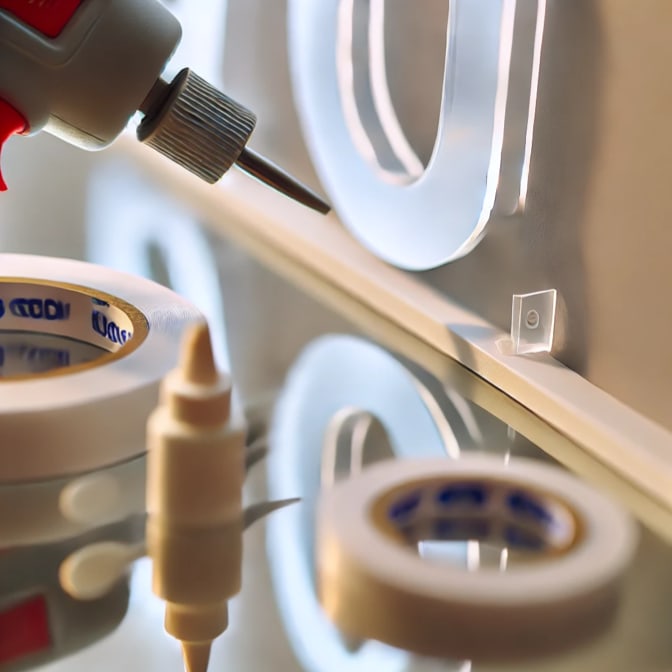
The search phrase “best glue for acrylic letters” combines two very different tasks. Fabricators may need to join one acrylic part to another. Installers may need to attach finished acrylic sign letters to paint, drywall, wood, metal, glass, masonry, or a backer panel. An adhesive designed for the first task may be wrong for the second.
Start by describing the complete assembly: acrylic product and thickness, surface finish or print, receiving substrate and coating, letter dimensions and weight, bond area, orientation, load, desired stand-off, interior or exterior exposure, installation access, appearance, and future removal. Then the responsible designer or installer can shortlist products whose manufacturers approve those conditions.
LA Prime Signs produces acrylic sign products from customer-approved artwork and verified dimensions. It does not survey the receiving surface, determine structural loads, specify a field adhesive or mounting design, prepare the site, or install the letters. Those decisions remain with the customer and qualified design, structural, and installation professionals.
Why does acrylic need a carefully matched adhesive?
Acrylic, or PMMA, can be cast, extruded, modified, coated, printed, mirrored, painted, or already stressed by cutting, drilling, bending, or polishing. Certain solvents and cleaning chemicals can cause crazing, whitening, cracking, or finish damage, especially around stressed edges. A joint that looks clear on scrap may behave differently on a formed or printed letter.
The receiving surface matters just as much. An adhesive may bond well to acrylic and poorly to low-surface-energy paint, chalky masonry, wallpaper, silicone-contaminated glass, powder coating, or a wall whose paint is only weakly attached. In that case, the “bond failure” may actually be the wall finish pulling away.
How do the main adhesive categories differ?
These categories are starting points, not specifications. Within each one, formulations have different viscosity, gap tolerance, strength, flexibility, UV stability, color, cure chemistry, hazard profile, service temperature, and approved substrates.
Solvent-based acrylic cement
Compatible solvent cements can soften mating acrylic surfaces so they fuse as the solvent leaves. Thin capillary products require close-fitting joints; thicker products may fill limited gaps but can leave a more visible bond line. TAP Plastics lists several plastic-adhesive types, illustrating why the product number and instructions matter more than the word “cement.”
Possible fit: controlled acrylic-to-acrylic fabrication approved by the product maker.
Important limits: not a general adhesive for mounting letters to arbitrary walls; fit, acrylic type, stress, technique, vapor control, ignition control, and cure all affect safety and appearance.
Two-part epoxy
Some epoxies can bond acrylic to metal, wood, or other materials and fill a defined gap. Others have poor plastic compatibility, cure too rigidly for movement, yellow or chalk outdoors, exotherm in thick sections, or print through a clear face.
Possible fit: a mixed-material joint when the exact epoxy is approved for both substrates and the load and environment.
Important limits: mix ratio, surface preparation, bond-line thickness, clamping, cure temperature, pot life, appearance, and long-term exposure are product-specific.
Acrylic foam or transfer tape
Pressure-sensitive tape can create a clean bond line and immediate handling support, but its long-term capacity depends on tape series, surface energy, bond area, pressure, dwell, temperature, peel or cleavage loads, substrate flatness, and whether the wall coating remains attached. “VHB” is a product-family term, not a universal load rating.
Possible fit: suitably sized interior letters or as part of a tested tape-and-adhesive system.
Important limits: thickness, edge visibility, initial versus developed bond, heat, cleaning, removal damage, and sustained load. Do not call a high-bond tape removable simply because it has no wet glue.
Silicone or other flexible sealant adhesive
Some flexible products tolerate movement and moisture, but adhesion to acrylic, paint, metal, glass, and masonry varies. Cure by-products, primer needs, joint depth, cure access, staining, color, and service rating must be checked. A product sold as a sealant is not automatically approved as the sole support for a sign letter.
Possible fit: a specifically designed and tested assembly that benefits from movement accommodation.
Important limits: low initial hold, cure time, squeeze-out, compatibility, dirt pickup, and uncertain load capacity without a defined joint.
Cyanoacrylate
Cyanoacrylates set quickly and can be useful in small, controlled assemblies when formulated for the materials. They can also bloom on clear acrylic, craze stressed parts, and create a brittle joint that performs poorly under peel, impact, or thermal movement.
Possible fit: product-approved small fabrication or fixturing tasks after testing.
Important limits: gap, humidity, appearance, shock, heat, long-term loading, skin bonding, and vapor exposure. Convenience does not make it the default permanent sign adhesive.
How should an acrylic-letter bond be prepared and tested?
Follow the chosen product's instructions and workplace safety program. A useful qualification process includes:
- Identify both materials: record acrylic product, fabrication history, coating or print, substrate, and wall-finish manufacturer when known.
- Inspect the support: do not bond over dust, chalk, loose paint, silicone, moisture, corrosion, weak wallpaper, or an unknown treatment.
- Use approved preparation: cleaner, abrasion, primer, flame treatment, and other methods are not interchangeable. Some can damage acrylic or create serious hazards.
- Test representative coupons: reproduce the actual finish, preparation, bond area, cure, temperature, and load direction; inspect appearance as well as adhesion.
- Plan alignment and temporary support: use a verified template and hold method without loading the uncured bond.
- Respect full cure: do not equate tack or fixture time with permission to hang, clean, ship, or expose the sign.
Read the label and safety data sheet before work. Control flammable vapor and ignition sources, ventilation, skin and eye exposure, spills, mixing, waste, and any required respiratory protection through qualified procedures. Do not use an adhesive in an occupied space merely because the container is small.
How should the adhesive system be chosen for the project?
Use a decision matrix rather than a universal product ranking:
- Acrylic-to-acrylic fabrication: consider a manufacturer-approved solvent or reactive system after confirming acrylic type, joint fit, clarity, stress, and production controls.
- Interior letters on a stable panel or wall: compare tested tape, adhesive, studs, backer, or combined systems by wall finish, weight, bond area, stand-off, removal, and consequence of failure.
- Heavy, overhead, public, or high-consequence letters: use qualified structural and installation review; adhesive-only support may be inappropriate.
- Exterior letters: address wind and other loads, heat, UV, moisture, coastal deposits where relevant, thermal movement, drainage, service, and mechanical support.
- Temporary or leased spaces: test both removal and wall-finish damage. “Removable” must describe the full assembly on the actual surface.
Dark letters and sun-facing walls can create high bond-line temperatures. Sites near saltwater can add deposits and moisture at edges and hardware. Neither condition points to one Southern California adhesive; both require the exact environmental limits and assembly to be checked.
How should an acrylic-letter project begin?
For production, provide vector artwork, customer-verified letter dimensions and thickness, acrylic product and finish, quantity, color, desired edge treatment, and any approved holes, studs, patterns, or other component specifications. The customer and qualified installer should separately document the receiving substrate, wall coating, loads, exposure, mounting height, removal plan, and landlord, accessibility, fire, egress, or permit criteria.
Review installation-ready production and handoff, then request an acrylic-letter production quote. LA Prime Signs can confirm supported material and fabrication options; the customer and responsible professionals retain adhesive selection, load capacity, mounting design, structural suitability, site verification, permits, access, and installation.
FAQ
What is the best glue for mounting acrylic sign letters?
There is no universal best product. The selection depends on acrylic type and coating, the receiving surface, letter weight and bond area, load direction, indoor or outdoor exposure, appearance, cure conditions, permanence, and whether mechanical support is needed.
Can super glue be used on acrylic sign letters?
Some cyanoacrylates are formulated for certain plastics, but others can bloom, craze acrylic, or create a brittle joint. Use only a product whose manufacturer approves the exact acrylic and assembly, then test on representative scrap.
How long should bonded acrylic letters cure?
Use the exact adhesive manufacturer’s schedule for the actual temperature, humidity, bond geometry, and materials. Fixture or handling time is not the same as full cure, and the assembly should not be loaded early.
Are solvent cements safe to use indoors?
Many release hazardous and flammable vapors and require controlled handling, ventilation, ignition control, and PPE defined by the label and safety data sheet. A generic respirator recommendation is not a substitute for a proper exposure-control program.
Which adhesive is best for exterior acrylic letters?
Exterior selection must account for heat, UV, water, salt where relevant, wall texture, thermal movement, wind and other loads, bond geometry, and service access. A tested adhesive system, backer panel, studs, or other mechanical support may be more appropriate than glue alone.