
Aluminum Signage: Why Alloy, Finish and Exposure Matter
Aluminum is a useful sign material because it is light for its stiffness, does not form iron rust, and accepts many finishes. The correct alloy, thickness, edge detail, coating, hardware, and exposure still decide how it performs.
Key takeaways
- Aluminum does not rust like iron or steel, but it can still pit, stain, corrode at cut edges, or react galvanically with dissimilar metals.
- Solid sheet, plate, extrusions, castings, and aluminum composite material have different structures and should not be treated as interchangeable.
- Alloy, temper, gauge, span, wind load, edge support, attachments, graphics, and finish matter more than the word aluminum by itself.
- Coastal salt exposure emphasizes compatible hardware, drainage, coating integrity, and cleaning; inland heat emphasizes solar gain, expansion, and graphic or coating limits.
- Recyclability is a potential end-of-life advantage, not proof that every coated, bonded, or composite sign will enter a local recycling stream.
- Production uses customer-approved finished dimensions; site verification, mounting design, engineering, permits, access, and installation belong to the customer and qualified professionals.
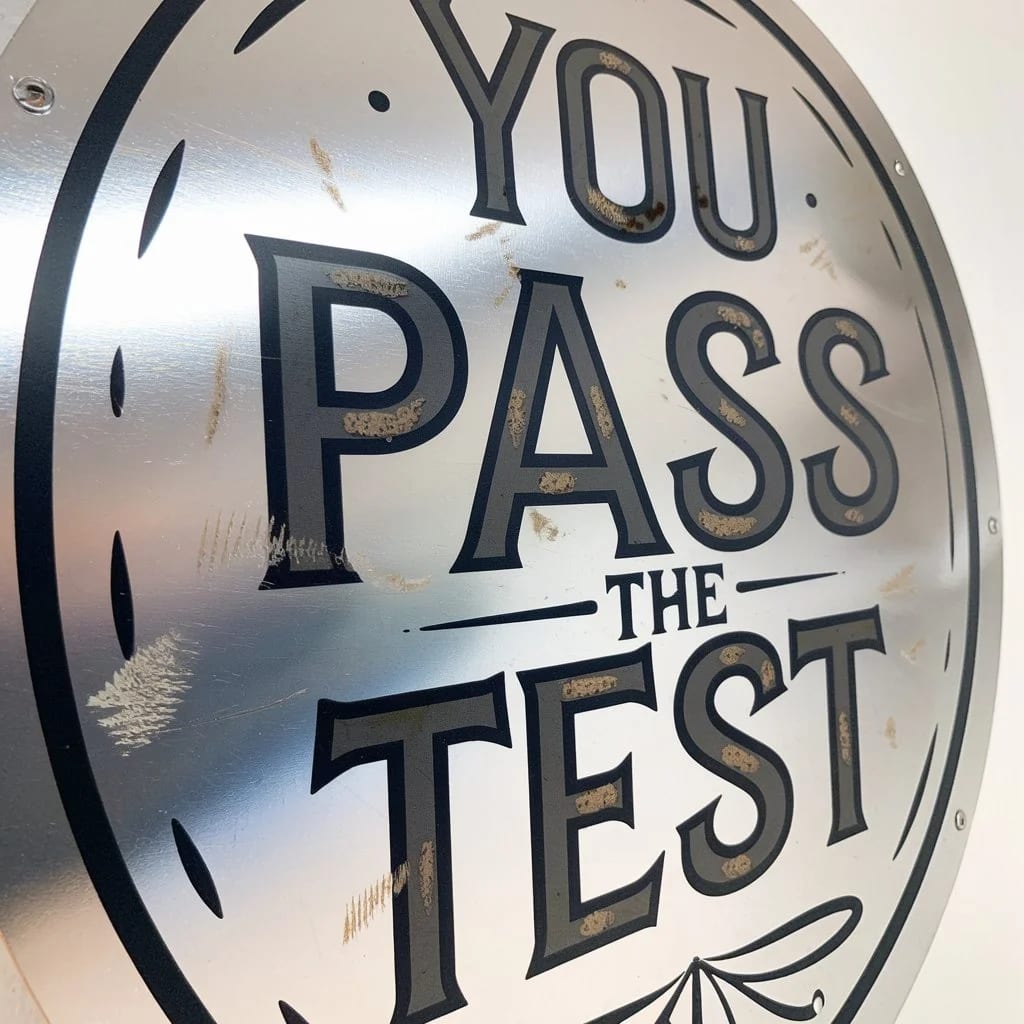
Aluminum signs can be thin panels, heavy plates, extruded frames, dimensional letters, fabricated cabinets, or skins bonded to a composite core. Those forms share a base metal but not the same stiffness, edge behavior, fastening, finish, or service limits.
For Los Angeles and Southern California work, aluminum is often a useful starting material—not an automatic final specification. A waterside identification panel, a sun-facing parking sign, and an indoor brushed plaque ask different things of the metal and its finish.
Why does aluminum resist rust and how can it still corrode?
When exposed to oxygen, aluminum develops a thin oxide film that helps protect the underlying metal. Alumeco’s corrosion overview explains this passive behavior and the conditions that can disrupt it.
Calling aluminum “rustproof” hides important failure modes. Chloride deposits, standing water, crevices, high- or low-pH contact, damaged coating, and electrical contact with a more noble metal can lead to pitting or galvanic attack. Isolate incompatible fasteners, protect cut edges where the system requires it, provide drainage, and inspect the complete assembly.
How does aluminum compare with other sign materials?
Every comparison needs a sign type and exposure:
- Wood: can deliver warmth and carve well, but species, grain, sealing, moisture movement, and maintenance require attention.
- PVC and acrylic: can be useful for protected, dimensional, or specialty applications, but heat movement, brittleness, expansion, impact, and UV response vary by product.
- Steel: can provide high strength and fabrication options, but weight and corrosion protection may increase field and maintenance demands.
- Aluminum: offers a favorable weight-to-stiffness balance and many finish routes, while thin sheet can still oil-can, dent, bend, or fatigue if it is under-supported.
For large flat panels, aluminum composite material may provide useful stiffness at low weight. Its bonded core and thin skins make it a different product from solid sheet, so edge exposure, routing, attachment, fire requirements, and recovery must be reviewed separately.
What customization options does aluminum offer?
The metal can support several production paths:
- Anodizing: modifies the oxide layer for an architectural or colored finish when the alloy, appearance tolerance, forming sequence, and environment suit the process.
- Powder or liquid coating: provides a broad color and sheen range after suitable cleaning and pretreatment; chemistry, cure, edges, and repair method affect performance.
- Applied or printed graphics: vinyl, direct print, and laminate systems must be matched to the finish, surface energy, expected heat, cleaning, and outdoor exposure.
- Brushed or polished metal: emphasizes the substrate itself but can show fingerprints, scratches, oxidation differences, and cleaning marks.
Routing, waterjet cutting, punching, bending, welding, casting, and machining may all be possible, but not every process fits every alloy, temper, thickness, or shop capability. Approve exposed edges, corner radii, grain direction, graphics, and finish samples before fabrication.
How does aluminum weight affect production and installer handoff?
Aluminum is substantially lighter than an equivalent volume of steel, which can reduce handling and packaging loads. It does not eliminate engineering, access, or attachment questions. Wind area, eccentricity, vibration, finished sign weight, wall construction, corrosion at hardware, edge distance, and hidden utilities still control the mounting design selected by the customer and qualified installer.
- Record alloy, thickness, customer-approved finished dimensions, framing, and finished assembly weight rather than describing the sign only as “lightweight.”
- The customer and qualified installer verify stucco, masonry, concrete, framing, panels, membranes, hidden utilities, and other concealed conditions before approving attachment details.
- Installer-approved fasteners and isolators must suit the structure, exposure, edge distances, and dissimilar-metal conditions.
- Use the installation-ready production and handoff guide to communicate approved patterns or hardware specifications before production; lifting, public protection, access equipment, and installation remain field-team responsibilities.
A thin panel can be easy to carry and still unsafe or visually poor if it flexes, catches wind, or lacks adequate edge support.
Is aluminum an environmentally preferable sign material?
Aluminum retains material value and can be recycled repeatedly through suitable systems. The Aluminum Association’s recycling information describes the energy advantage of producing secondary aluminum compared with primary metal.
A finished sign’s outcome is more complicated. Paint, adhesive, laminate, composite cores, embedded hardware, contamination, local processor acceptance, dismantling, and transport affect recovery. Ask about recycled content, repairability, separability, and the actual local end-of-life route instead of labeling every aluminum sign “eco-friendly.”
How should cost and long-term value be compared?
Compare the complete produced-and-installed system while separating responsibilities: substrate, framing, finish, graphics, and written production options belong in the shop quote, while field verification, access, attachment, maintenance, repair, and the replacement trigger belong in the customer’s project plan. A thicker or better-finished panel may cost more initially yet reduce deformation or coating work; a protected short-term sign may not need that specification.
No generic material article can promise a 10-, 20-, or 30-year life or claim aluminum always beats PVC, wood, steel, or ACM. Use a side-by-side scope tied to the same dimensions, exposure, visual standard, and mounting conditions.
Where are aluminum signs commonly used?
Common applications include:
- Building and storefront identification: panels, dimensional letters, cabinets, backers, and address elements.
- Wayfinding: directories, post-and-panel systems, parking information, and room or site identification.
- Operational messages: property rules, equipment labels, and custom safety information when the responsible party supplies and approves the content.
- Interior architectural work: brushed plaques, reception details, display panels, and fabricated frames.
Regulatory, traffic, fire, accessibility, and safety signs may require prescribed substrates, colors, reflectivity, legends, mounting, or approvals. Familiarity with aluminum does not replace those project requirements.
How should an aluminum sign project begin?
Gather the approved message and artwork, customer-verified finished dimensions, viewing distance, customer-supplied site photos, installer-approved mounting requirements, desired edge and finish, exposure, expected cleaning, and any governing sign standard. Note whether the design calls for solid aluminum, an extrusion, or a composite panel.
LA Prime Signs produces custom aluminum signs from approved artwork, final dimensions, and written specifications. Send those production inputs for a quote. Field measurements, site verification, mounting design, structural suitability, electrical decisions, permits, code compliance, access, and installation are not included.
FAQ
Do aluminum signs rust?
Aluminum does not create iron oxide rust, but it is not immune to deterioration. Chlorides, trapped moisture, incompatible fasteners, damaged coatings, alkaline contact, and crevices can cause pitting, staining, galvanic corrosion, or loss of finish.
Are aluminum signs suitable near the coast?
They can be, when the alloy, finish, edges, fasteners, isolators, drainage, cleaning, and mounting details suit the exposure. Coastal suitability should be specified for the complete assembly rather than assumed from the base metal alone.
Is solid aluminum the same as aluminum composite material?
No. Solid sheet or plate is metal throughout. Aluminum composite material typically bonds thin aluminum skins to a core, so its edge behavior, stiffness, fastening, fire properties, routing, repair, and recycling path differ.
How long does an aluminum sign last?
There is no universal service life. Alloy, thickness, finish, graphics, orientation, pollution, salt, irrigation, impact, mounting, cleaning, and maintenance all matter. Use product data and the project exposure to set expectations.
Which finishes can be used on aluminum signs?
Depending on the alloy and process, options can include anodizing, conversion treatment with paint, powder coating, liquid coatings, applied film, direct print, laminate, brushing, and polishing. Confirm that the complete finish system is compatible and intended for the exposure.
Does LA Prime Signs survey or install aluminum signs?
No. LA Prime Signs produces aluminum signs from customer-approved artwork, final dimensions, and specifications. The customer and qualified installer are responsible for field verification, mounting design, structural suitability, permits, code compliance, access, and installation.