
Octotech's Blue Acrylic Office Sign: Project Study
This historical Octotech project pairs a glossy blue panel and light logo with rounded corners and four wood-grain mounting blocks. It documents completed work, not a current installation offering.
Key takeaways
- The historical source operation created this blue acrylic office sign for Octotech; the project location is not specified, and it is not Los Angeles-local proof.
- The photograph supports a literal description of a glossy blue panel, rounded corners, a light logo and wordmark, four wood-grain corner blocks, and a textured wall.
- Project notes describe laser etching, paint fill, and black walnut mounting pieces.
- Acrylic grade, thickness, edge finish, mounting load path, wall attachment, accessibility, and update needs still require a current specification.
- Simple office identification can carry strong brand character when color, finish, typography, mounting, and background are coordinated.
- Current orders are production only: customers and qualified installers supply verified dimensions and own mounting, structural, accessibility, code, access, and installation decisions.
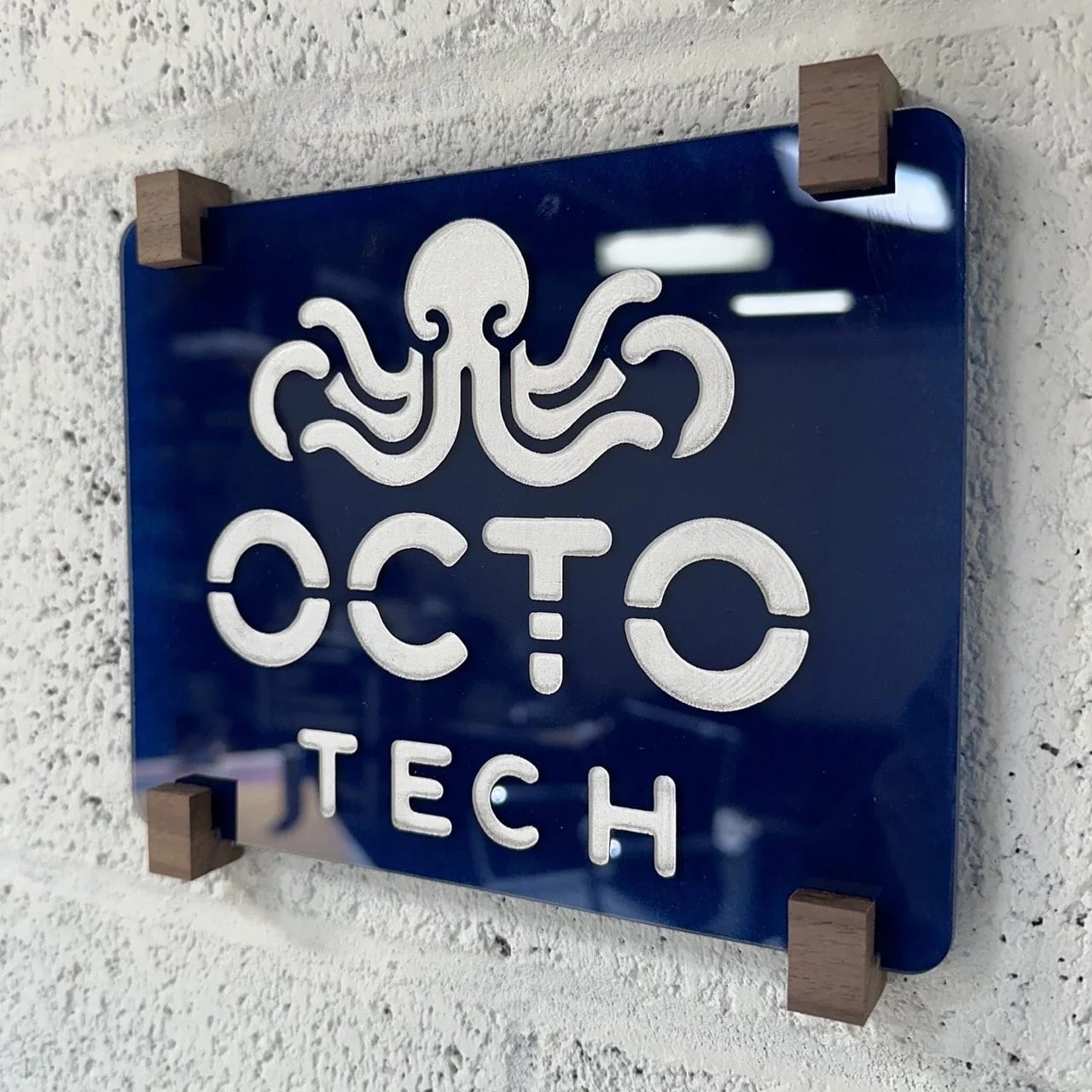
The historical source operation created this blue acrylic office sign for Octotech. The project photograph shows the finished plaque, logo treatment, softened corners, wood mounting blocks, and textured wall; the project location and installation party are not specified. The mounted result is historical evidence, not Los Angeles-local proof or a current installation offer.
The piece is worth studying because a compact office identifier combines blue acrylic, a light octopus mark and wordmark, softened corners, wood blocks, and a textured wall without adding decorative clutter.
What does blue acrylic contribute to this office sign?
The photograph shows a saturated blue panel with a glossy or translucent appearance. That color creates the field for the light Octotech mark, while the rounded corners reduce the visual sharpness of the rectangle. Reflections are visible on the face, which is a reminder that color and contrast must be reviewed under the actual interior lighting.
Project notes identify the material as blue Plexiglas, a trade name commonly used for acrylic. Erie Industrial Plastics’ acrylic overview describes general properties such as lower weight than glass and useful optical clarity. The exact resin, thickness, impact rating, color, surface, and fire or building requirements for this plaque are not documented here.
For a new acrylic sign, approve a physical color sample and edge detail. A swatch on a screen cannot show transmission, reflections, wall color, fingerprints, or how mounting pressure will appear through the panel.
How was the logo treatment created?
Project notes say the Octotech logo was laser etched into the acrylic and then paint-filled. The photograph shows a light, textured mark against a glossy blue field. Etch depth, paint chemistry, masking, and cure should be specified for a new version of this treatment.
For a similar treatment, the design review should test small counters, narrow gaps, paint coverage, cleanability, and contrast at the actual size. Etching the reverse face, front face, or a separate applied layer can produce different depth, shadow, and maintenance behavior.
What do the wood corner blocks contribute?
Four square wood blocks overlap or capture the plaque near its corners. Their warm brown tone separates the blue panel from the pale textured wall and makes the mounting method part of the composition rather than trying to hide it.
Project notes identify the wood as black walnut. The Wood Database’s black-walnut reference provides species-level hardness and durability information, but species data alone does not establish a mounting assembly’s load capacity. Grain direction, moisture content, finish, fasteners, wall anchors, acrylic clearance, and block geometry determine whether a mounting detail is suitable.
Wood and acrylic also move differently with humidity and temperature. A current detail should avoid pinching the panel, provide any required clearance, and make removal possible without damaging the wall or plaque.
How was the sign fabricated?
The project narrative describes five steps:
- Panel cutting: sizing the blue acrylic and forming rounded corners.
- Logo etching: creating the light-marked areas in the approved artwork.
- Paint filling: adding contrast within the etched artwork.
- Wood-block fabrication: shaping and finishing the four corner components.
- Component coordination: coordinating the panel, blocks, and fastener locations for the finished assembly shown in the photograph.
That sequence captures the main fabrication stages. For a new sign, the approved production drawing should document the exact panel, artwork, finishes, wood blocks, customer-verified finished dimensions, and installer-approved fastener locations. The customer and qualified installer separately document the wall attachment and installation responsibilities.
What can Los Angeles-area office-sign planners learn from this project?
The lesson is coordination. A small sign can feel intentional when each element has one job: the blue field carries brand color, the light mark provides contrast, the rounded profile softens the form, and the wood blocks connect mounting with appearance.
For a current office project, review:
- the exact room, suite, tenant, and accessibility identification requirements
- artwork ownership and the approved brand file
- customer- or installer-verified wall texture, concealed conditions, permitted penetrations, and property criteria
- viewing height, glare, contrast, cleaning, tamper resistance, and future name changes
LA Prime Signs produces custom acrylic signs from approved artwork, final dimensions, and written production specifications. If this material combination is relevant, send the artwork, customer-verified dimensions, desired acrylic and finish, and installer-approved hole or hardware specifications for a production quote. Site verification, mounting design, structural suitability, accessibility, code, permits, access, and installation remain the customer and qualified installer’s responsibility.
FAQ
Who created the Octotech office sign?
The historical source operation created this blue acrylic office sign for Octotech. The project location is not specified, and the project is not evidence of Los Angeles-area work.
What can be confirmed from the project image?
The image shows a translucent or glossy blue rectangular plaque with rounded corners, a light octopus logo and Octotech lettering, and four square wood corner blocks mounted against a textured wall.
How was the Octotech sign fabricated?
Project notes describe blue Plexiglas or acrylic, laser etching, light paint fill, and black walnut mounting pieces. A similar sign should still receive a current material, finish, and mounting specification.
What should be specified for a similar office sign?
Confirm the acrylic type and thickness, color and opacity, edge treatment, artwork rights, contrast, customer-verified finished dimensions, installer-approved attachment details, cleaning, accessibility criteria, and how names or suites will be updated.
Does this historical project mean LA Prime Signs currently installs office signs?
No. The photograph documents a completed mounted sign, but the installation party is not identified here. LA Prime Signs provides production only and does not perform site surveys, mounting design, permitting, or installation.