
Temporary Event Signs: A Practical Planning Guide
Temporary signs still need a real plan: who must notice what, at which decision point, for how long, in which conditions, with whose permission, and without creating wind, trip, sight-line, egress, or accessibility problems.
Key takeaways
- Map the audience journey—arrival, parking, entry, check-in, destination, action, and exit—before choosing quantities or sign types.
- Match material and support to duration, indoor or outdoor use, wind exposure, handling, surface permission, transport, storage, and reuse.
- Letter-height rules of thumb are starting points; message length, font, contrast, angle, speed, distance, clutter, and viewing time still require testing.
- Confirm property approval and the address-specific jurisdiction, event, right-of-way, fire, building, accessibility, and sign requirements before placement.
- Temporary must not mean disposable by default: reusable frames, changeable inserts, neutral wayfinding, and documented storage can reduce remakes when the program repeats.
- LA Prime Signs produces approved sign and banner components; the customer and event team own site verification, placement, setup, weather monitoring, permits, access, and removal.
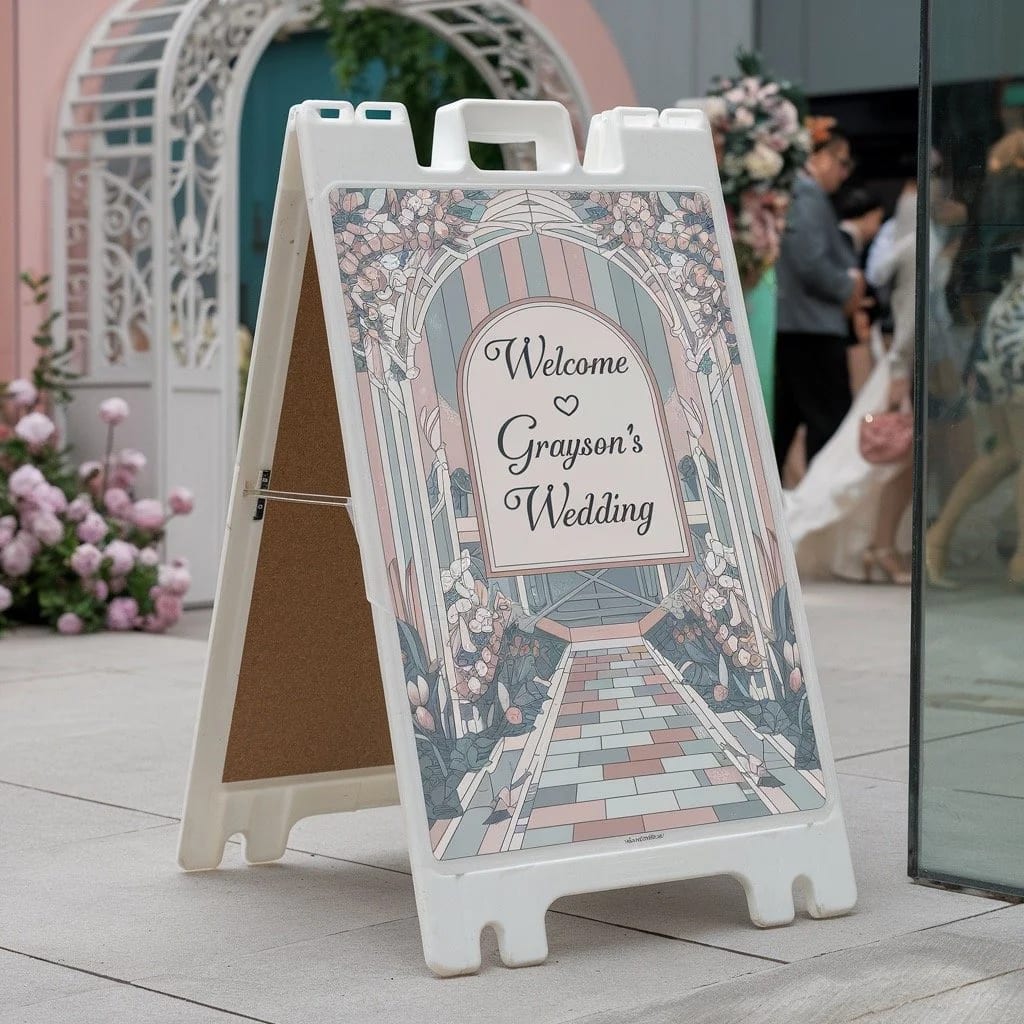
Temporary signs help people notice an event, choose an entrance, find parking or check-in, understand an offer, and confirm they have reached the right place. Their service period may be short, but the communication, property, weather, and public-safety questions are real.
A Los Angeles-area street promotion, hotel meeting, outdoor wedding, convention booth, school event, or grand opening will not use the same sign package. LA Prime Signs provides custom banner production and supported printed sign components from customer-approved artwork and finished dimensions. It does not survey venues, obtain permits, place signs, provide event setup, or coordinate field access.
Begin with decisions and conditions, then have the customer, venue, and qualified setup team choose a system that is approved and stable for the job.
What makes temporary signage different from permanent signs?
Temporary signs prioritize deployment, change, transport, storage, and removal. That can justify lighter materials and replaceable inserts, but it does not justify unreadable art or improvised mounting. A sign used for one afternoon may still face wind, crowds, sprinklers, vehicle sight lines, or an accessible route.
List each sign by role:
- Awareness: identify the event or promotion early enough for a viewer to respond.
- Direction: support a decision at parking entries, turns, elevators, doors, or paths.
- Confirmation: reassure people after a turn and identify the destination.
- Action: explain check-in, registration, pickup, ordering, or another next step.
- Operations: communicate staff-only, safety, queue, closure, or schedule information through the approved system.
The same graphic should not be forced into every role. A street-level awareness banner and a close-range check-in instruction need different message density and construction.
Which materials fit temporary signs?
Material selection should include the print or applied graphic, support, attachments, base, edge, and expected environment as one assembly.
Corrugated plastic panels
Fluted polypropylene is light, printable, and common for short-duration directional panels and yard-style signs. Flute direction, thickness, panel size, edge exposure, stakes or frame, wind, heat, ink, and reuse affect performance. It can bow, crease, pull off supports, or become a sail; do not assign a universal one-to-two-year outdoor life.
Consider for: approved short-term direction or information where a suitable support and recovery plan are available.
Vinyl and mesh banners
Banners can cover a large area and roll for transport, but media weight alone does not establish wind suitability. Span, hem, reinforcement, grommet or pole-pocket design, attachment spacing, structure, edges, wind exposure, flame requirements, ink, and removal plan all matter. Mesh changes wind load and image density; it does not make every fence or facade attachment safe.
Consider for: property-approved rail, frame, fence, stage, or facade locations designed for the selected banner system.
Foam board and paper-faced display board
Foam-centered display boards can work for dry indoor easels, presentations, table signs, and protected exhibits. Many paper-faced products are vulnerable to moisture, denting, edge damage, heat, and repeated handling. Confirm flame or venue requirements rather than assuming “indoor” is the only condition.
Consider for: supervised interior use where the board is supported and kept away from moisture, heat, egress, and impact.
Rigid PVC and reusable frames
Rigid PVC panels can create a smoother, more substantial insert, but sheet formulation, thickness, heat movement, span, flame properties, support, graphics, and disposal or reuse need review. Reusable A-frame signs can accept changeable inserts when the base, ballast, path clearance, wind rating, and property rules suit the location.
Consider for: repeated programs or higher-touch displays where a durable frame or panel will actually be stored and reused.
How should temporary signs be designed for a quick read?
A temporary sign often competes with unfamiliar surroundings and a viewer focused on another task. Edit the message until the primary action is obvious.
Letter size starts with the viewing task
Signs.com’s letter-visibility guide describes the common one-inch-per-ten-feet shortcut. Use it only to establish an early test size. A driver, pedestrian, seated guest, queue, or close-range reader has different dwell time, angle, motion, and consequences.
Test the longest real message at the intended distance. Increase size or shorten copy when font width, low contrast, glare, speed, or clutter makes the first estimate weak.
Contrast must survive the site
Light-on-dark or dark-on-light pairs often create useful value separation, but the material and background can change it. A white sign may disappear against a pale tent; glossy black can reflect the sky; translucent color may shift when backlit. Review the print or film on the real support in relevant sun, shade, interior light, and night conditions.
Typeface and spacing serve the message
Choose letterforms with open counters, adequate stroke, and spacing for the task. A script may suit a close-up wedding welcome yet fail for parking direction. A condensed face may fit more words while slowing recognition. Preserve the brand where it works and use a supporting text style where clarity demands it.
Message hierarchy should lead to one next step
Put the event, destination, arrow, date, offer, or action in the order viewers need it. Secondary details can move to a close-range confirmation sign or accessible digital page. Do not make a roadside panel carry registration terms, a full menu, multiple sponsors, and directions at once.
Where should temporary signs be placed?
Placement belongs to the customer, venue, and responsible event professionals. Their plan should give viewers enough time and space to respond without blocking people, vehicles, doors, equipment, or required paths.
Place direction before the decision point
Locate signs where the intended viewer can see, understand, and safely act before a turn, entrance, queue, or split. Add confirmation after the decision. A sign placed at the destination cannot prevent a wrong turn upstream.
Choose height around viewers and access
“Eye level” is not one universal four-to-six-foot band. Seated and standing viewers, children, crowds, displays, parked vehicles, landscaping, counters, and accessible reach or mounting criteria differ. Keep bases and projecting parts out of required clear paths and preserve door, elevator, fire-equipment, and egress access.
Orient the face toward the actual approach
A sign parallel to movement may have little readable exposure. Angle or duplicate signs only where the property and support system permit it, and confirm that the placement does not create a vehicle sight-line obstruction, pedestrian pinch point, or wind problem.
Review daylight, shade, and night use
Map when the message matters. Direct sun can create glare or fade a low-density print; deep shade can reduce contrast; a night event may need approved ambient or sign lighting. Do not add cords, battery packs, generators, candles, or improvised lighting without venue, fire, electrical, trip-hazard, weather, and qualified-use review.
Which permissions and rules apply to temporary signs?
The property address determines the responsible jurisdiction and owner. Temporary sign rules can vary among Los Angeles, other Southern California cities, unincorporated areas, ports, campuses, fairgrounds, convention facilities, shopping centers, hotels, HOAs, and special districts. An event permit does not automatically approve every sign, and private-property approval does not authorize use of public land or a right-of-way.
- Confirm the approving parties: property owner or manager, venue, event organizer, landlord, and official agencies as applicable.
- Verify sign limits: type, area, height, duration, quantity, support, illumination, placement, and removal.
- Protect public function: traffic sight lines, sidewalks, accessible routes, egress, fire equipment, utilities, and emergency operations.
- Review content-specific rules: political, real-estate, alcohol, sponsor, safety, or regulated messages may have additional requirements.
Use current official guidance for the exact event and site. Do not promise a permit exemption or approval time from a generic article.
What should the customer and event team plan for setup?
“Temporary” describes duration, not the consequence of a falling, windblown, sharp, electrically unsafe, or obstructive object. The following are planning boundaries for the responsible venue and setup team, not universal installation instructions.
Use approved non-damaging supports
Wire stakes, easels, bases, frames, hooks, tapes, ties, clamps, and grommets are not interchangeable. Soil, buried utilities, wall finish, glass, fence ownership, support capacity, product rating, removal, residue, and venue rules determine what is allowed. The qualified setup team must obtain permission and select a compatible method before anything is drilled, staked, taped, tied, weighted, or suspended.
Plan for wind and weather
Obtain manufacturer limits for the complete stand or banner assembly and follow venue weather procedures. Coastal gusts and moisture may be relevant at one site; inland heat, hard sun, and thermal movement may dominate another. Ballast must be designed and placed without creating trip or access hazards; improvised weights do not establish wind safety.
Assign setup, inspection, and removal
Name the person responsible for setup, pre-opening inspection, weather monitoring, repositioning, damage response, closing removal, transport, and storage. Keep large, elevated, electrical, street-adjacent, or structurally loaded work within qualified scope. The installation-ready production and handoff guide helps organize customer-supplied dimensions and setup specifications; it is not event setup, field measurement, access coordination, or permit service.
How can temporary-sign performance be measured?
Choose a measure tied to the sign’s role. Count wrong turns or wayfinding questions; observe queue confusion; compare check-ins by entrance; record which offer code was used; or ask a short post-event question. A QR code can help with optional close-range action, but it should not replace a readable destination or critical instruction.
- Privacy: define what analytics or personal data are collected, who controls them, and what notice or consent applies.
- Accessibility: provide a human-readable URL or alternate method and do not require a camera action for essential access.
- Connectivity: test the live destination and mobile service at the venue before printing.
- Records: photograph installed locations and note which signs were moved, damaged, ignored, or repeatedly requested.
Use the observations to improve the next event rather than claiming that a scan count proves the sign caused a sale.
Which temporary-sign mistakes are avoidable?
- Too much copy: split awareness, direction, confirmation, and detail into appropriate stages.
- Material chosen by price alone: include support, weather, handling, venue, storage, and reuse.
- Late permission review: identify property and jurisdiction requirements before production.
- Missing decision points: walk the audience route from arrival through exit before finalizing quantities.
- Improvised mounting: specify each location and support instead of sending tape and ties as the entire plan.
- No strike plan: schedule removal, inventory, cleaning, recycling or disposal, and storage while the event team is still assigned.
How should a temporary-sign project begin?
Provide the event dates, audience routes, customer-approved site plan and sign schedule, exact messages, languages, verified finished dimensions, viewing distances, indoor or outdoor conditions, desired reuse, installer-approved support specifications, and needed date. Identify which signs are required for safety, accessibility, traffic, fire, or event approval so the responsible professionals can review them.
Send those approved production inputs for a quote. LA Prime Signs prints, cuts, and finishes only the temporary sign and banner components stated in the quote. Field measurements, site verification, mounting and ballast design, venue and agency approvals, permits, code compliance, placement, access, setup, inspection, weather response, electrical work, and removal remain the customer and qualified event team’s responsibility.
FAQ
Which material is best for a temporary outdoor sign?
There is no universal best. Corrugated plastic, banner media, rigid PVC, reusable frames, and other products suit different durations, spans, wind, support, print, fire, handling, storage, and recovery needs. Use manufacturer data and the actual setup.
How large should event-sign letters be?
Base the size on the exact message, font, stroke, contrast, viewing distance, angle, speed, dwell time, and obstructions. One inch per ten feet is a common planning shortcut, not a guarantee or code; test the full message in context.
Does a temporary sign need a permit in the Los Angeles area?
Requirements vary by address, jurisdiction, property, sign type, event, zone, location, size, duration, support, and whether public property or a right-of-way is involved. Verify with the property owner and the official agencies responsible for that site.
How can temporary signage be made more reusable?
Use durable reusable frames, separate date-specific inserts from neutral directional pieces, avoid unnecessary event-year references, document sizes and locations, protect graphics during transport, and confirm that the chosen material has an actual storage or recovery plan.
Does LA Prime Signs place or set up temporary event signs?
No. LA Prime Signs produces only the sign and banner components stated in the quote. The customer and event team are responsible for site measurements, venue and agency approvals, supports, placement, ballast, setup, inspection, weather response, access, and removal.