
Juniper Cafe Blade Sign Installation on Polk Street, San Francisco
A bright custom lightbox blade sign for Juniper Cafe in San Francisco, made with laser-cut white plexiglass, translucent UV printed vinyl, and enough sidewalk energy to qualify as an unofficial street performance.
Scope label — produced and installed under the previous operating model: The prior operation fabricated and installed this blade sign for Juniper Cafe on Polk Street in San Francisco on Memorial Day 2025. This is a historical Bay Area record, not a Los Angeles project.
Current-service boundary: LA Prime Signs provides production only. The customer or qualified installer supplies final field dimensions and is responsible for cabinet and site verification, mounting design, structural and electrical decisions, permits, code compliance, access, and installation.
- Blade sign
- Lightbox face
- UV printed vinyl
- Mars 130 laser
- Historical San Francisco install
Memorial Day 2025: the croissant line has entered the chat
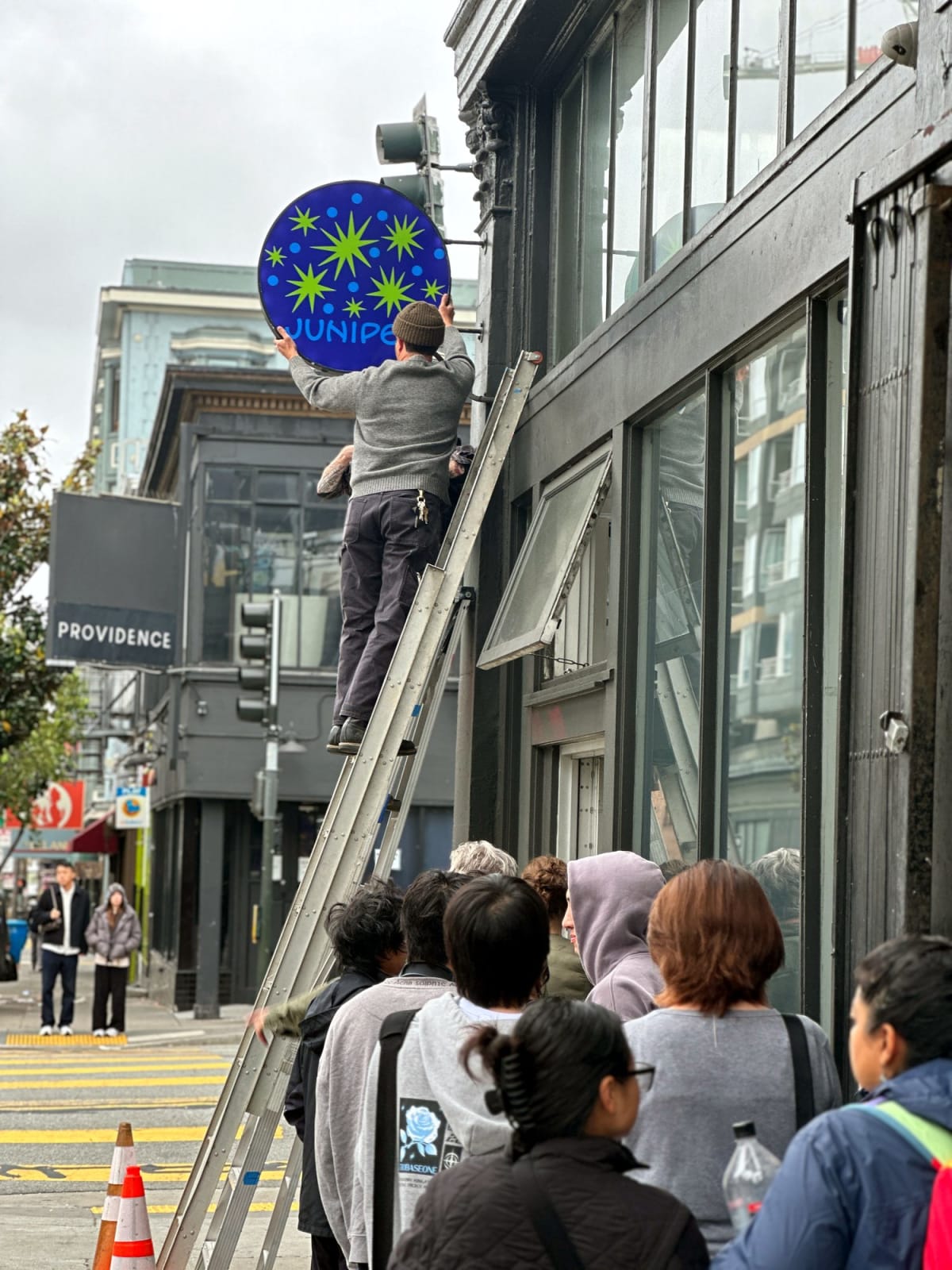
Lauren at Juniper Cafe needed a blade sign with real presence: bright, round, readable from the sidewalk, and cheerful enough to compete with the smell of laminated pastry. Bam. In your face. Here's the sign. Here's the door. Here's your pastry.
The historical crew arrived on Monday, May 26, 2025, which was Memorial Day. The surviving record places the work on an active Polk Street sidewalk and identifies Mikey and Cameron as part of the installation sequence. It does not establish a current service model, customer volume, award, or Los Angeles connection.
The job was straightforward on paper: install a custom illuminated blade sign face about 16 feet up. The real-world version included extension ladders, pedestrians, pastry anticipation, camera phones, and in my head, I was thinking, "Damn. There's 75 people here watching me, Cameron, and Mikey. We better not mess this up."
- ScopeProduced and installed under the previous operating model
- ClientJuniper Cafe
- ContactLauren
- LocationPolk Street, San Francisco
- Historical install dateMemorial Day 2025
- Sign typeIlluminated blade sign face
- MaterialSign-white plexiglass
- Cut methodMars 130 laser
- Graphic and finishUV-printed translucent vinyl applied to the round faces
- Artwork recordJuniper palette and graphic shown; file-preflight details not documented
- Packaging / handoffNot separately documented; the prior operation performed the historical installation
- Install heightAbout 16 feet
- ResultBright round face readable from the Polk Street sidewalk
How we made the Juniper lightbox blade sign face
The sign face started as custom-cut sign white plexiglass. We used our Mars 130 laser cutter to cut the plex cleanly, because circles should be circles, not "yeah, it kinda looks like a circle." For a round lightbox blade sign, that clean edge matters. If the face is off, every little problem gets lit up later.
Then we produced the graphics as UV printed translucent vinyl and installed the vinyl onto the plexiglass faces. The key word is translucent. Regular opaque vinyl can look great in daylight and then block too much light at night. Translucent vinyl keeps the color punchy while allowing the lightbox to glow through the artwork. Juniper's palette is bright blue, green, and lavender, so the sign needed to stay lively instead of turning into a gloomy dinner plate after sundown.
The result was a custom lightbox sign face that could read from the sidewalk, photograph well, and still look like it belonged to a cafe with serious pastry discipline. For a current production request, compare acrylic sign production, storefront sign production, and the Mars 130 laser guide.


Historical 16-foot install: extension ladders, spotters, and no heroic nonsense
Blade sign installation is one of those jobs where everyone sees the charming finished sign and nobody sees the quiet checklist behind it. Ladder angle. Footing. Spotter position. Tool staging. Public sidewalk awareness. Hardware. Wind. People with croissants trying to drift into the work zone because the pastry tractor beam is strong.
Safety came first. We used extension ladders, kept the ground support active, stayed clipped and controlled where the site called for it, and worked the sign face into the lightbox without turning the sidewalk into a slapstick routine. The slapstick was emotional. The ladder work was boring on purpose.
The funny part is that from the street it probably looked like a tiny festival: bright sign, people in line, possible busker soundtrack, Mikey calling out positions, Cameron doing that intense installer squint, and me trying to look calm while a very expensive circle hovered above a very hungry crowd.
Questions people ask about custom blade signs, answered without making it weird
What is a blade sign?
A blade sign is a sign that projects perpendicular from a building, so pedestrians can see it while walking down the sidewalk. For cafes, bakeries, restaurants, boutiques, salons, and small shops, a blade sign is often more useful than a flat wall sign because it catches side-approach foot traffic.
Why was Juniper's sign face made from white plexiglass?
White plexiglass, often called white acrylic, is a common lightbox face material because it diffuses light and gives the printed graphic a clean backing. For Juniper, it also gave us a precise round substrate that could hold the translucent vinyl artwork and sit cleanly in the blade sign cabinet.
Why use UV-printed translucent vinyl instead of paint?
UV printed translucent vinyl is excellent for illuminated signs because it gives you detailed color, crisp artwork, and light transmission. Paint can be beautiful, but for a bright graphic lightbox face with exact brand colors and repeatable production, printed translucent vinyl is the practical hero.
Could a similar blade-sign face be produced for third-party installation?
A production review can cover a laser-cut acrylic face and translucent printed graphics when the customer supplies approved artwork, verified final face dimensions, and the existing cabinet and lighting specifications. Send those production details through the project form. The customer or qualified installer remains responsible for field verification, cabinet compatibility, mounting, electrical work, permits, code compliance, access, and installation.
What should a blade-sign production handoff include?
Include customer-verified final face dimensions, the number of faces, approved artwork, viewing orientation, cabinet-retainer details, lighting compatibility information, and any installer-approved production specifications. The installation-ready production page explains the handoff boundary; field measurements, mounting design, structural and electrical decisions, permits, access, and installation are not included.
Need an acrylic blade-sign face produced for installer handoff?
Send approved artwork, customer-verified final face dimensions, quantity, viewing orientation, required translucent-graphic details, and the installer-approved cabinet specifications. LA Prime Signs can review the production scope without taking responsibility for the field or electrical work.